



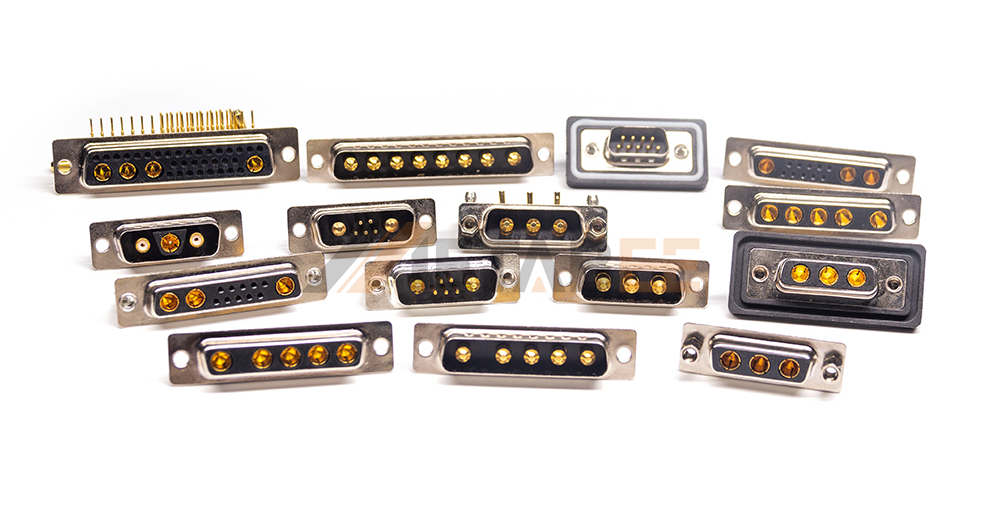
In the world of electrical and electronic connectivity, few connector families have demonstrated the longevity and versatility of the D-Subminiature (commonly known as D-Sub) and the rugged circular M12 connectors. Although they were developed decades apart and for very different original purposes, both remain indispensable in 2025 – one as the enduring standard for data and mixed-signal applications, the other as the de-facto choice for harsh-environment sensor and industrial Ethernet networks.
Part I – The Timeless D-Subminiature Connector
Origins and the Iconic “D” Shape
The D Subminiature connector was first introduced by Cannon (later ITT Cannon) in 1952. The distinctive trapezoidal metal shield that gives the family its name was designed to provide robust EMI/RFI shielding while allowing high-density pin arrangements in a relatively compact footprint. The “D” series was originally intended as a smaller, lighter alternative to the bulky rack-and-panel connectors used in early mainframe computers and military equipment.
The standardization of D-Sub connectors quickly followed:
- DE-9 (9 pins, often mistakenly called DB-9) – serial communication
- DA-15 (15 pins) – early VGA and game ports
- DB-25 (25 pins) – parallel printer ports and original RS-232
- DC-37, DD-50, and high-density variants (15, 26, 44, 62, 78 pins) for telecom and industrial control
Even though USB, HDMI, and Ethernet have largely replaced D-Subs in consumer devices, the family refuses to fade away in professional sectors.
Why D-Sub Connectors Are Still Everywhere in 2025
- Unmatched Reliability in Mixed-Signal Applications Aviation, broadcast, medical instrumentation, and test & measurement equipment still rely heavily on D-Sub because they can combine power, low-level analog signals, high-speed digital lines, and even coaxial or pneumatic inserts in a single shell.
- Military & Aerospace Pedigree MIL-DTL-24308 (M24308) qualified D-Sub variants are specified in countless legacy and current platforms. Replacing them would require expensive re-qualification of entire systems.
- Superior EMI/RFI Shielding The full metal shield and 360° backshell options still outperform many newer plastic-bodied connectors in electrically noisy environments.
- Combination D-Sub (Combo-D) Modern Combo-D connectors mix high-current power contacts (up to 40 A) and high-speed contacts (up to 10 Gbps differential pairs) in the same housing – something that very few circular or rectangular alternatives can match cost-effectively.
- Cost and Availability Billions of D-Sub connectors have been manufactured. Tooling is fully amortized, and second-source manufacturers in every corner of the globe keep prices extremely competitive.
Current Trends in D-Sub Technology
- Waterproof IP67/IP68 D-Sub connectors (both panel and cable versions)
- Filtered D-Subs with integrated Pi-filter or feed-through capacitors for EMI suppression
- High-density 0.8 mm pitch variants for space-constrained applications
- Right-angle and vertical PCB versions with 100 Ω differential pairs for 5–10 Gbps data (used in modern broadcast routers)
- Ruggedized “military-style” versions with black zinc-nickel plating and extended temperature ranges (−55 °C to +200 °C)
Part II – The Rise of the M12 Connector in Automation
From Simple Sensor Connections to Industrial Ethernet
The M12 connector with its threaded metal coupling nut was standardized in the early 1990s under IEC 61076-2-101 (later expanded by many additional detail specifications). Originally designed as a robust alternative to RJ45 and proprietary sensor plugs in factory environments, the M12 has evolved dramatically.
Key coding types in daily use today:
- A-coded (mostly 3–17 poles) – traditional sensor/actuator and fieldbus (Profibus, CANopen, DeviceNet)
- B-coded – Profibus and some legacy fieldbus variants
- D-coded (4 poles) – 100 Mbit/s Industrial Ethernet (EtherNet/IP, Profinet up to 2010)
- X-coded (8 poles) – Cat6A, 10 Gbit/s Ethernet, 500 MHz, PoE++ up to 100 W
- L-coded (4+FE) – PROFINET DC power (up to 5 A per pin) and 100 Mbit/s data
- K-coded – future 24 V / 16 A power applications
- S-coded and T-coded – legacy AC and DC power variants now largely replaced by L-coded
Why M12 Has Become the Universal Industrial Connector
- Environmental Resistance IP65/IP67 (mated) is the baseline; IP68 and IP69K versions are common. Stainless-steel and plastic (V4A, PBT, PUR) variants survive washdown, chemicals, UV, welding sparks, and mechanical shock.
- 360° Shielding and EMC Performance Especially important with the migration to single-pair Ethernet (10BASE-T1L) and high-speed Gigabit links in noisy factories.
- Standardization and Interoperability Nearly every automation vendor (Siemens, Rockwell, Beckhoff, Bosch Rexroth, Balluff, Pepperl+Fuchs, etc.) offers M12 cables and receptacles. A Profinet X-coded cable from one manufacturer will mate and perform identically with devices from any other.
- Power over Data Line (PoDL) and PoE X-coded M12 now routinely delivers up to 100 W (IEEE 802.3bt Type 4) alongside 10 Gbit/s data, eliminating separate power cabling in many robotic and vision applications.
- Single Pair Ethernet (SPE) The newest M12 variants for 10BASE-T1L and 1000BASE-T1 use only two wires for distances up to 1000 m (10 Mbit/s) or 40 m (1 Gbit/s), opening the door to true “Ethernet to the edge” in process automation and building infrastructure.
Recent Innovations (2023–2025)
- M12 “Push-Pull” locking mechanisms (IEC 61076-2-010) that achieve IP67 sealing without threading – dramatically reducing installation time.
- Hybrid M12 connectors combining X-coded data + L-coded power in a single connector (saving panel space).
- M12 versions with integrated electronics (IO-Link masters, managed switches, or even tiny edge computers inside the overmolded housing).
- High-temperature M12 (up to 150 °C continuous) using FEP or PEEK insulators for steel mills and glass manufacturing.
Comparing D-Sub and M12 – When to Choose Which
| Feature | D-Subminiature (D-Sub) | M12 Circular |
| Typical environment | Indoor, panel/rack, moderate shock | Harsh, outdoor, washdown, vibration |
| Pin count flexibility | Extremely high (up to 104 in HD) | Limited (max 12 poles commercially) |
| Shielding | Excellent (full metal shell) | Excellent (metal coupling nut) |
| Locking mechanism | Two jackscrews or slide locks | Threaded or push-pull |
| Mixed signal/power/coax | Best-in-class (Combo-D) | Limited (hybrid versions emerging) |
| Data speed | Up to ~10 Gbps differential pairs | Up to 10 Gbit/s (X-coded) & SPE |
| Cost per mated pair | Very low | Moderate to high |
| Legacy installed base | Massive (1950s–present) | Large but newer (1990s–present) |
In practice, the two families are often used together on the same machine:
- D-Sub for the control cabinet backplane or PLC I/O cards
- M12 for distributed sensors, actuators, and Ethernet drops on the factory floor
The Future Outlook
D-Subminiature connectors will almost certainly remain in production for another 30–50 years, driven by aerospace, defense, and high-end industrial applications where re-qualification costs outweigh any advantages of newer alternatives.
M12 connectors, on the other hand, are still expanding their territory. With the arrival of Advanced Physical Layer (APL) for intrinsically safe Ethernet in process plants and the ongoing standardization of M12 for Single Pair Ethernet, the M12 family is positioned to become the single universal field-level connector for the next generation of Industry 4.0 and IIoT installations.
Conclusion
The D-Subminiature and M12 connectors represent two different eras of industrial connectivity – one born in the vacuum-tube age, the other in the age of distributed automation. Yet both continue to evolve, proving that good engineering rarely becomes obsolete; it simply finds new applications. Whether you are restoring a 1970s broadcast router, wiring a modern automotive assembly line, or building the sensor network for a smart factory in 2025, chances are you will still reach for either a D-Sub or an M12 – and both will serve reliably for decades to come.
