



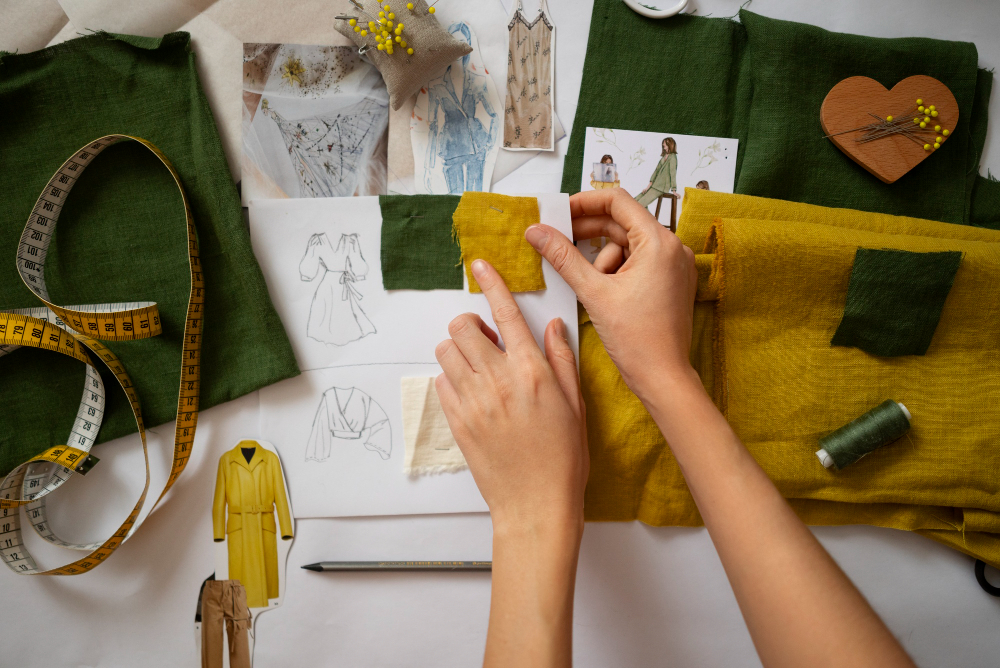
In an era where fast fashion dominates headlines and mass production seems unstoppable, there remains a quiet revolution happening in ateliers, design studios, and home sewing rooms around the world. Serious designers, couture enthusiasts, and sustainable fashion advocates are returning to the foundational skill that separates ready-to-wear from truly exceptional garments: professional pattern cutting.
While many people can sew a straight line or follow a commercial pattern, the ability to translate a creative vision into a perfectly fitting, beautifully draped garment begins long before the first stitch. It begins with understanding how to manipulate flat pieces of paper (or digital equivalents) into three-dimensional forms that celebrate the human body. This is the magic of pattern cutting, and it is a craft that cannot be fully mastered through YouTube tutorials or PDF downloads alone.
What Exactly Is Pattern Cutting?
Pattern cutting (also called pattern making or block drafting) is the technical process of creating the templates from which garments are constructed. These templates dictate every curve, dart, seam allowance, and ease that will eventually become a finished piece of clothing. A well-cut pattern can make an inexpensive fabric look luxurious; a poorly cut one can ruin the finest silk.
There are several established methods of pattern cutting taught around the world:
- Flat pattern cutting – The most common method in industry, where basic blocks (slopers) are manipulated using pivot, slash-and-spread, or drafting techniques.
- Modelling on the stand (or draping) – A more intuitive, three-dimensional approach favored in haute couture where fabric is draped directly on a dress form and then translated into flat patterns.
- Made-to-measure systems – Specialized techniques for creating bespoke patterns tailored to individual measurements.
- Computer-aided design (CAD) – Modern digital pattern making using software like Gerber, Lectra, Optitex, or Clo3D.
Each method has its devoted followers, but the most accomplished pattern cutters are fluent in several approaches and know when to use which.
Why Serious Designers Invest in Professional Pattern Cutting Courses
While it’s possible to learn basic skills through self-study, professional Pattern cutting courses offer something irreplaceable: structured progression under expert guidance. Here’s what separates a comprehensive course from scattered online tutorials:
1. Mastering Proportion and Balance
Understanding how to distribute ease, create silhouette, and maintain design integrity across sizes requires years of trained observation. Professional instructors can spot when a shoulder is 3mm too extended or when a dart rotation has thrown off the entire balance of a jacket – subtleties that are impossible to teach through video alone.
2. Learning Industry-Standard Techniques
From notch placement to grainline perfection, professional courses teach the invisible details that separate amateur and professional work. These standards ensure patterns can be clearly understood by sample machinists, graders, and factory workers anywhere in the world.
3. Developing Critical Eye and Problem-Solving Skills
Pattern cutting is as much about diagnosis as creation. When a toile (muslin prototype) doesn’t hang right, students learn to identify whether the issue is in the armhole depth, back width, bust dart placement, or a combination of factors. This analytical skill develops only through repeated practice with qualified feedback.
4. Understanding Different Fabrics and Their Behavior
A pattern cut for crisp cotton poplin will fight against fluid silk crepe. Professional courses teach students how to adapt patterns for different fabric weights, drapes, and stretch properties – knowledge that comes from handling hundreds of meters of different textiles under expert supervision.
5. Building Speed and Commercial Awareness
While couture has the luxury of time, most professional pattern cutters work in environments where efficiency matters. Structured courses teach students to work quickly without sacrificing precision – an essential skill for anyone hoping to work in fashion houses or launch their own label.
Essential Tools of the Trade: Beyond Scissors and Rulers
Any serious pattern cutter will tell you that having the right tools makes an enormous difference in both accuracy and enjoyment of the work. While beginners often start with basic supplies, professionals invest in specialized equipment that becomes an extension of their hand.
The Indispensable Fabric Cutter
At the very top of this list sits the professional fabric cutter. While many home sewists make do with dressmaking shears, anyone cutting multiple layers or working with difficult fabrics quickly discovers the limitations of traditional scissors.
Modern electric fabric cutters have revolutionized the cutting room. These machines can slice through dozens of layers with perfect precision, maintaining exactly 90-degree angles and eliminating the hand fatigue that comes with cutting heavy fabrics like denim or multiple layers of lining. For anyone producing small production runs or samples regularly, investing in a reliable Fabric cutter is not a luxury – it’s a necessity.
The difference becomes particularly obvious when cutting slippery fabrics like silk charmeuse or chiffon. Where scissors inevitably shift layers and create tiny imperfections that compound throughout construction, a high-quality fabric cutter glides through with surgical precision.
Other Essential Professional Tools
- Pattern notcher – Creates precise notches faster and more consistently than scissors
- Awl – For marking dart points and drill holes accurately
- French curves and hip curves – Essential for drawing smooth, professional armholes and crotch curves
- Pattern drills – For marking internal points that need to be transferred through multiple layers
- 1-inch pattern paper – The industry standard with grid markings for perfect alignment
- Cardstock for permanent blocks – Unlike paper patterns that degrade, cardstock blocks last for years
From Classroom to Atelier: Real-World Success Stories
The proof of proper training lies in the results. Graduates of rigorous pattern cutting programs can be found at every level of the fashion industry:
- Working as head pattern cutters at major fashion houses in Paris, London, and New York
- Launching successful independent labels with perfectly fitting signature pieces
- Becoming technical designers who bridge the gap between creative design and production reality
- Teaching the next generation of pattern makers at prestigious fashion schools
- Running made-to-measure and couture ateliers where every garment is cut individually for the client
Many of today’s most respected contemporary designers – from independent slow fashion labels to luxury ready-to-wear houses – either trained extensively in pattern cutting themselves or employ master pattern cutters who did.
The Future of Pattern Cutting Education
The rise of digital pattern making has not diminished the need for traditional skills – if anything, it has increased it. Today’s pattern cutters need to be bilingual, fluent in both traditional hand drafting and modern CAD systems. The best contemporary pattern cutting courses reflect this reality, teaching students to draft by hand first (developing the essential understanding of garment construction) before progressing to digital methods.
Sustainability concerns are also reshaping pattern cutting education. With increasing awareness of fashion’s environmental impact, courses now emphasize zero-waste pattern cutting, creative layout techniques to minimize fabric usage, and methods for creating versatile, long-lasting garments rather than disposable fashion.
Is Professional Training Worth the Investment?
For anyone serious about fashion design, the answer is unequivocally yes. The cost of professional pattern cutting courses represents not an expense but an investment in skills that will pay dividends throughout a design career.
Think of it this way: a designer who cannot cut their own patterns will always be dependent on others to interpret their vision. They will spend countless hours explaining adjustments to pattern makers, waiting for revisions, and compromising when communication fails. A designer who masters pattern cutting controls every aspect of their creative vision from sketch to finished garment.
In the words of one Savile Row master cutter: “Give me a well-cut pattern, and I can make magic with even the simplest cloth. Give me a poor pattern, and even the finest fabric will look cheap.”
For those ready to move beyond following commercial patterns and begin creating truly original, perfectly fitting garments, the path is clear. Professional pattern cutting courses remain the gold standard for developing this essential fashion skill – and in an industry increasingly dominated by mass production, the ability to create beautiful, individual patterns has never been more valuable.
Whether you dream of launching your own label, working in haute couture, or simply creating perfectly fitting clothes for yourself and others, the journey begins with understanding how to transform flat fabric into three-dimensional beauty. And that understanding begins with proper training in the art and science of pattern cutting.
