



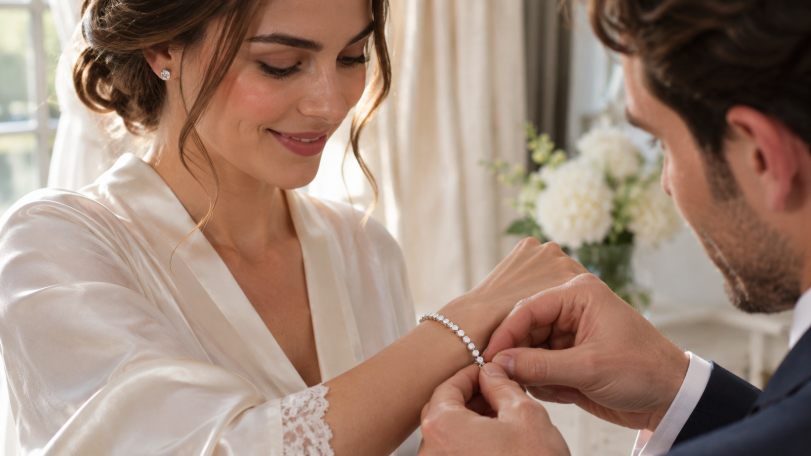
A proposal often brings one piece of jewellery into the spotlight: the engagement ring. Yet there are other moments in a relationship that deserve their own keepsake, from the day a couple announces their engagement to the evening before their wedding. A diamond tennis bracelet can mark these occasions without competing with a ring.
The design is relatively simple, but buying one involves decisions that are easy to overlook. A continuous row of stones needs to move comfortably, sit neatly against the wrist and stay secure when the wearer reaches for a coat or slips a bag over their arm.
Choosing a Bracelet That Moves Naturally
Unlike a rigid bangle, a traditional tennis bracelet consists of connected settings that allow it to bend around the wrist. The quality of those connections affects how the bracelet feels as the wearer moves.
When comparing a lab diamond tennis bracelet from Novita Diamonds with designs from other jewellers, pay attention to the spacing between stones. A fine row of closely arranged round diamonds creates a different effect from larger stones separated by visible sections of metal.
Measure the wrist with a flexible tape, then consult the retailer’s sizing advice for that particular design. The bracelet needs enough room to move without sliding too far towards the hand. If it is a surprise gift, measuring a bracelet that the recipient already finds comfortable may provide a useful starting point.
Ask about alterations before placing an order. Shortening a stone-set bracelet may require removing individual links, and not every design can be adjusted easily.
Read Beyond the Total Carat Weight
A bracelet advertised as having three carats contains three carats of diamonds altogether. It does not tell you how large each individual stone is.
Consider two hypothetical bracelets of equal length. One contains 30 diamonds totalling three carats, while another contains 60 diamonds with the same combined weight. The first averages 0.10 carats per stone and the second 0.05 carats, producing quite different visual effects if the stones have similar proportions.
Look for details about the number of diamonds, their dimensions and their colour and clarity ranges. Small differences between individual stones may be less distracting than a single diamond that looks noticeably darker than its neighbours.
A Companion Piece for an Engagement Ring
Couples planning a surprise proposal may already have considered lab grown diamonds for the engagement ring. A bracelet featuring laboratory-grown stones could become a separate gift for the wedding morning or a later anniversary, particularly if the recipient enjoys wearing jewellery on their wrist.
According to the Gemological Institute of America, laboratory-grown diamonds share essentially the same material and light-related properties as natural diamonds. The difference lies in their origin, not in whether they are made of diamond.
There is no requirement for the bracelet and ring to use identical gemstone shapes. A simple line of round stones can sit happily beside an oval engagement ring. Matching the metal colour may create a sense of continuity, but mixing yellow and white gold is also a matter of personal preference.
Inspect the Fastening, Not Just the Diamonds
The clasp deserves close attention because the bracelet depends on it staying closed. A box clasp with a separate safety catch provides a secondary fastening if the main mechanism opens.
Ask Novita Diamonds or another jeweller to explain how the fastening works and whether the clasp can be serviced or replaced. Try closing it with one hand if buying for yourself. A fastening that feels awkward in the shop may become frustrating at home.
Claw settings expose more of each stone, while bezel settings surround its edge with metal. Consider which design is less likely to catch on the cuffs of clothing you regularly wear.
Buying with the Years Ahead in Mind
British shoppers should check for an approved hallmark on precious-metal bracelets where the legal weight thresholds apply. For gold, the exemption covers articles with a precious-metal weight below one gram. A hallmark confirms the metal’s fineness; it does not verify the diamonds.
Request an itemised quotation in pounds, written confirmation of the gemstone origin and details of the retailer’s repair and resizing arrangements. Ask whether individual stones can be replaced if needed.
At home, follow the jeweller’s cleaning advice, store the bracelet separately from other pieces and remove it before activities that may put strain on the links. A jeweller can inspect a loose setting or unreliable catch before it becomes a bigger problem.
A milestone gift should fit the person receiving it rather than an imagined dress code for special occasions. If the bracelet feels comfortable with a favourite shirt, sits securely on the wrist and brings back a happy memory, it has found a place in the wearer’s life well beyond the celebration.
About the Author & Publisher
Editorial and publishing enquiries are handled by Fatima Tariq. For professional content writing, article publishing, guest posting, SEO services or business collaborations, please contact [email protected].