



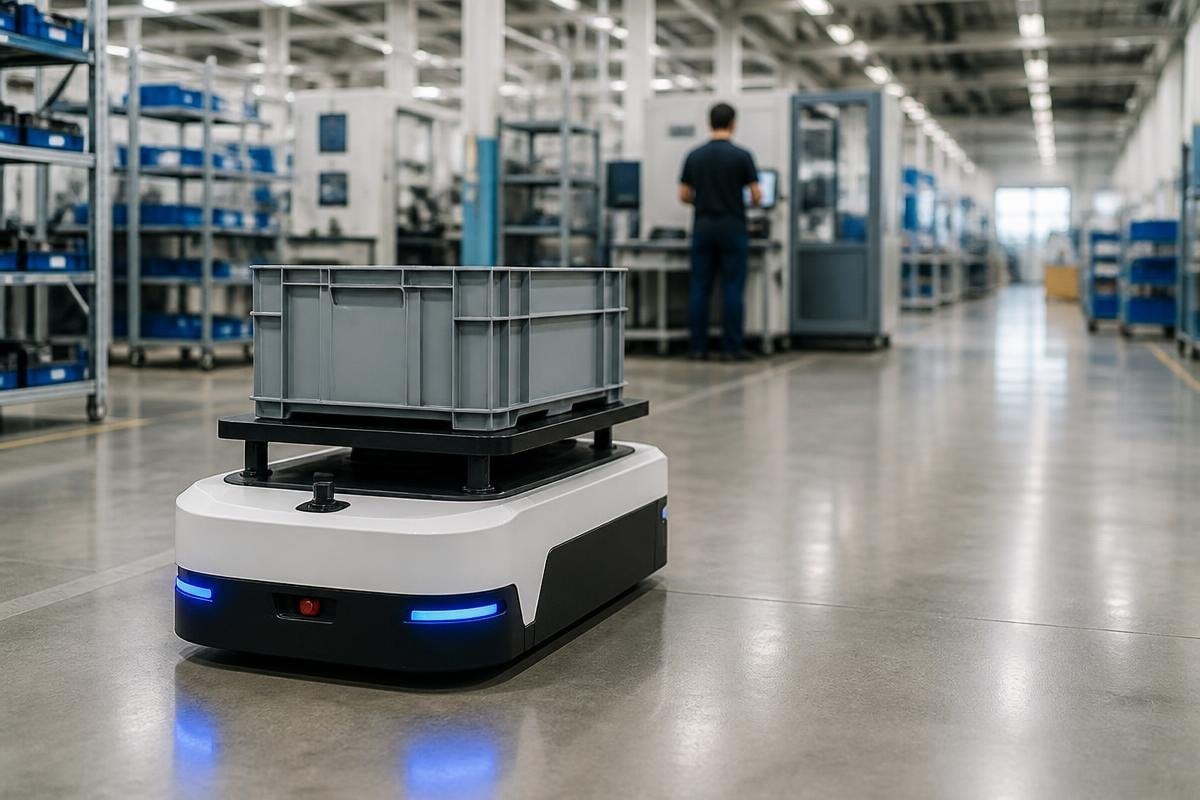
An autonomous mobile robot, or AMR, moves goods through a site without a person driving it from room to room. Its value comes from small repeated trips: carrying a tote, bringing a pallet, or feeding parts to a work cell.
- AMRs build maps and choose routes around people and equipment.
- LiDAR, cameras, and safety sensors help them stop before contact.
- The hard work starts at the site boundary, where floors, doors, traffic, and software must agree.
How an AMR finds its route
An AMR uses sensors to measure the space around it. LiDAR sends out laser pulses and reads their return, while cameras can help identify objects, signs, or docking points. Those readings combine with a digital map of the site.
That map gives the robot a starting point, but it doesn’t remove every problem. A worker may leave a cart in an aisle, a door may close, or a pallet may sit outside its marked area. It must detect the change, slow down, and choose another safe route.
Some sites add QR codes, magnetic tape, or other markers at fixed points. These tools can help with docking and position checks, especially near racks or conveyors. A good setup uses the robot’s sensors and the site’s physical layout together instead of asking software to solve every problem.
Where the work changes
AMRs are useful when a task repeats and the route has a clear purpose.
A robot can carry parts between storage and assembly, move finished goods to inspection, or take waste to a collection point. Staff then spend less time walking between work areas.
That change matters most when a site loses time between tasks. A worker who walks several times each hour may cover the same path again and again. An AMR can handle that movement while the worker loads, checks, or repairs equipment.
A person still needs to place goods correctly, clear a blocked route, and deal with a damaged load. Automation moves the work around. It doesn’t remove the need for a clear process.
The software link matters
An AMR works as part of a larger system. It may receive a job from warehouse software, a manufacturing execution system, or a fleet manager that assigns work to several robots. The message must include the pickup point, delivery point, load type, and priority.
A fleet manager also prevents robots from meeting in narrow aisles or waiting at the same charging dock. That requires clean maps and clear traffic rules. ROS 2 may connect robot software in some projects, but the full system still depends on the site software and the maker’s own tools.
A robot that avoids aisle conflicts in one site may still need different rules elsewhere. Robotics reports from Robot24.com can place deployment claims beside named machines and test results before the next section checks the limits buyers should see.
Limits that buyers should check
The floor is part of the robot’s job. Uneven surfaces, ramps, reflective walls, poor lighting, and tight doorways can affect travel and sensing. A robot that works in a marked test area may need changes before it can share a busy production route.
Loads create another limit. The payload rating covers weight, but shape and balance matter too. A tall box can block sensors or shift during a turn. A soft bag may need a different carrier from a rigid tote, even when both weigh the same.
Safety work needs its own review. ISO 3691-4 sets safety requirements for driverless industrial trucks, including many automated guided vehicles and AMRs. A buyer still needs a site risk review, marked walkways, emergency stops, and staff training because the standard doesn’t inspect your particular floor.
I’d buy an AMR for a repeat transport task with stable pickup points, but I’d skip a purchase until the site team maps exceptions and measures the manual process.
A practical buying check
Use this list before asking for a quote:
- Name the load: record its weight, size, balance, and container.
- Map the route: check doors, ramps, lifts, narrow aisles, and crossing points.
- Count the trips: measure pickups, deliveries, waiting time, and walking time.
- Test the handoff: confirm how the robot loads, unloads, and reports a failed delivery.
- Plan recovery: assign people to blocked routes, low batteries, damaged loads, and sensor faults.
- Set a pass mark: choose the travel time, delivery rate, and safety result the trial must meet.
A small pilot should answer those points before a larger purchase. The next useful step is a site trial that records every stop and manual intervention, then compares that record with the cost of keeping the route human-run.