



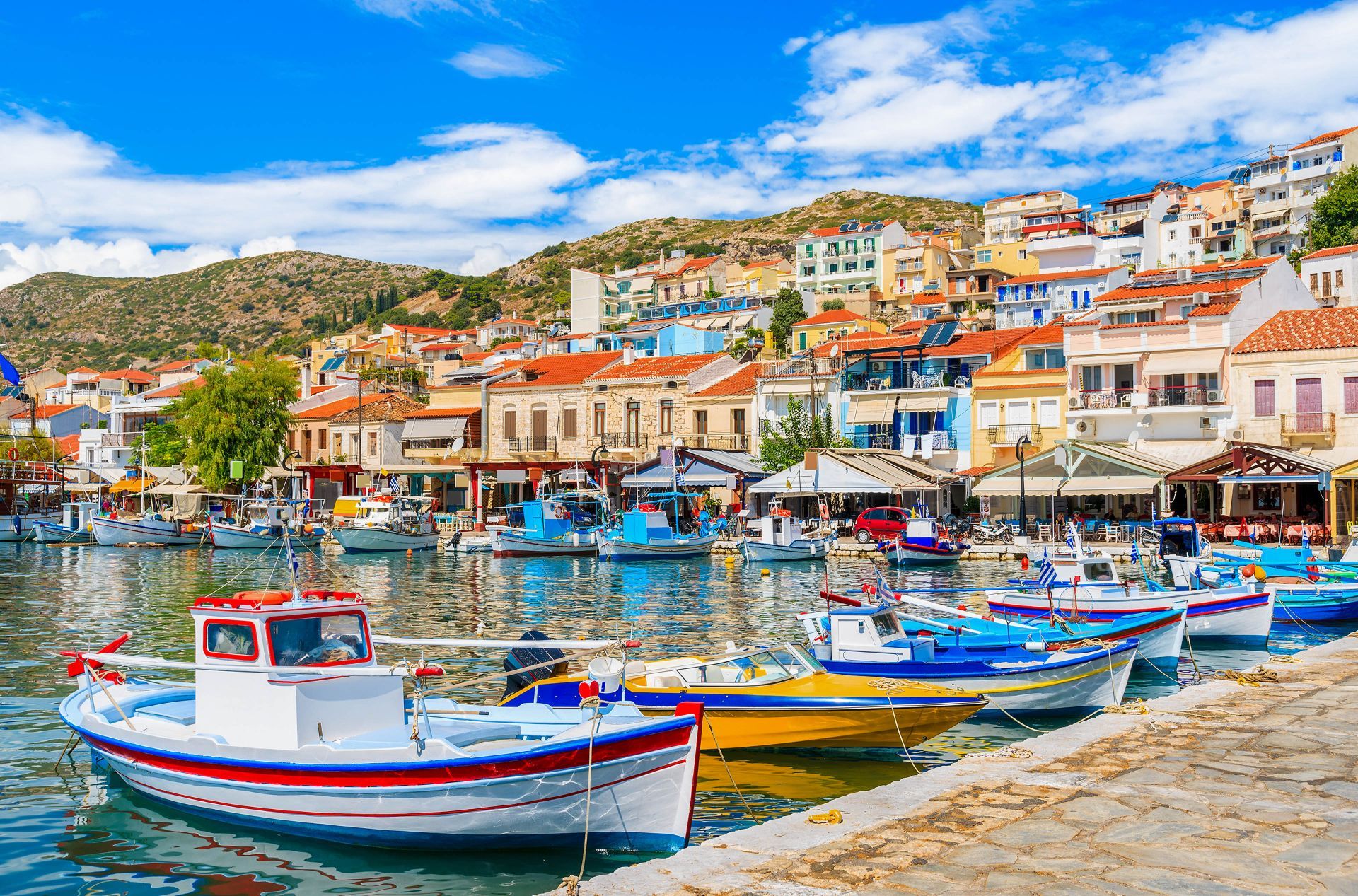
The North Aegean islands have long lived in the shadow of their more famous Cycladic and Dodecanese cousins. While Santorini and Mykonos battle for Instagram supremacy, two larger, greener and infinitely more authentic islands – Samos and Lesvos (also known as Lesbos) – continue to offer the kind of Greek island experience that many travellers thought had vanished decades ago. Pine-covered mountains, pristine beaches, exceptional food, world-class ouzo and a genuine welcome await those willing to venture slightly off the main tourist trail. Whether you’re planning Holidays in Samos or holidays to Lesvos, you’re in for an unforgettable Aegean adventure.
Samos: The Island of Pythagoras, Wine and Waterfalls
Just a stone’s throw from the Turkish coast, Samos feels like a different Greece altogether. Lush, mountainous and almost impossibly green for a Greek island, it’s a place where thick forests tumble down to turquoise bays and hidden waterfalls crash into natural swimming pools.
The Beaches: From Secluded Pebbles to Golden Sands
Samos boasts some of the most varied coastline in Greece. In the northwest, the pebble beach of Potami is backed by a river gorge that leads to two stunning waterfalls – perfect for an adventurous morning swim followed by lunch at one of the traditional tavernas in nearby Karlovasi.
For classic beach-lounger holidays in Samos, head south to the golden sands of Psili Ammos or the long sweep of Mykali beach, where the water takes on an almost Caribbean clarity. The tiny beach of Tsamadou, framed by dramatic cliffs and pine trees reaching almost to the water’s edge, regularly appears on lists of Europe’s most beautiful beaches – and yet you’ll rarely struggle to find a sunbed.
Villages That Time Forgot
While many Greek islands have lost their traditional character to mass tourism, Samos has somehow preserved its soul. The mountain villages of Vourliotes, Manolates and Stavrinides feel like stepping back in time. Narrow cobbled streets, wooden balconies dripping with bougainvillea, and tiny kafenia where old men play tavla (backgammon) and argue about politics. Manolates in particular has become something of an artists’ colony, with pottery studios and jewellery workshops tucked into the hillsides.
The capital, Vathy (also called Samos Town), curves elegantly around one of the Aegean’s most beautiful natural harbours. The upper town of Ano Vathy retains its neoclassical mansions and narrow lanes, while the waterfront buzzes with life in the evening as locals and visitors mingle in the bars and restaurants.
Wine and Nightingales
Samos is synonymous with sweet, golden wine. The Muscat grape has been cultivated here for millennia, and the island’s cooperative produces some of Greece’s most celebrated sweet wines. The best way to understand this tradition is to drive the “wine road” that winds through the island’s northern slopes, stopping at small producers and the excellent wine museum in Vathy.
In late spring, the valleys around Mytilinioi echo with the song of nightingales – a phenomenon celebrated every year with the “Nightingale Festival”, where locals and visitors gather in the countryside to listen to these extraordinary songbirds under the stars.
Historical Heavyweights
Birthplace of Pythagoras, the mathematician who gave us the famous theorem, and home to one of antiquity’s greatest engineering feats – the Eupalinian aqueduct, a 1km tunnel built through solid rock in the 6th century BC – Samos packs a historical punch. The tunnel, described by Herodotus as the greatest of the three wonders of the Greek world, can still be walked today. The archaeological museum in Vathy houses treasures from the UNESCO-listed Heraion temple complex, while Pythagorio – the island’s second town – is built over the remains of the ancient capital.
Lesvos: The Third-Largest Greek Island You’ve Probably Never Considered
If Samos is lush, Lesvos is positively verdant. The third-largest Greek island (after Crete and Evia) is a world away from the white-and-blue stereotype. Olive groves stretch as far as the eye can see – Lesvos produces some of Greece’s finest olive oil – while pine forests cloak the mountains that rise to almost 1000 metres.
Mytilene: One of Greece’s Most Beautiful Island Capitals
The island’s capital, Mytilene, is a revelation. Its seafront is lined with grand Ottoman-era mansions, and the massive Byzantine castle crowns the hill above the town. The archaeological museum and the Theophilos Museum (dedicated to the “naive” painter who captured 20th-century island life) are both excellent, but the real joy is simply wandering the back streets, discovering hidden churches and Ottoman hammams, and drinking coffee in the sprawling harbour cafes.
Petrified Forest: A Geological Wonder
One of Europe’s most important natural monuments lies on Lesvos’s western coast. The Petrified Forest, created 20 million years ago when volcanic eruptions covered a subtropical forest in ash and lava, features massive fossilised tree trunks complete with roots and branches. The excellent visitor centre and the walking trails through this surreal landscape make for a fascinating half-day trip.
Hot Springs and Healing Waters
Lesvos has been famous for its thermal springs since Roman times. The beautifully restored Ottoman bathhouse at Thermi, the natural hot pool that flows directly into the sea at Eftalou, and the modern spa facilities at Polichnitos all offer different ways to experience the island’s healing waters. The spring at Eftalou is particularly magical – imagine soaking in 46°C water while looking out over the Aegean towards Turkey.
Ouzo and Sardines: The Holy Trinity of Lesvos Cuisine
Lesvos is the undisputed capital of ouzo production. The town of Plomari on the south coast is home to some of Greece’s most famous distilleries – Varvagianni, Barbayanni and Mini among them. Many welcome visitors for tours and tastings. The traditional way to drink ouzo here is accompanied by meze plates of local specialities: salted sardines from Kalloni Gulf (considered the best in Greece), grilled octopus, and fresh vegetables preserved in the island’s excellent olive oil.
The fishing village of Skala Kalloni virtually shuts down every June for the Sardine Festival – three days of music, dancing and, of course, countless grilled sardines washed down with ice-cold ouzo.
Molyvos: Possibly Greece’s Most Beautiful Village
Crowned by a Byzantine castle and tumbling down a hillside to a perfect horseshoe harbour, Molyvos (also called Mithymna) is the postcard image of a Greek island village. The stone houses with their wooden balconies, the cobbled streets too narrow for cars, the restaurants spilling onto the harbour front – it’s almost impossibly picturesque. Yet despite its beauty, Molyvos has avoided the overtourism that plagues similar villages on more popular islands.
The Literary Connection
Lesvos has a rich intellectual tradition. It was the birthplace of Sappho, the ancient poet whose verses about love between women gave us the terms “lesbian” and “sapphic”. More recently, the island was home to Nobel laureate Odysseas Elytis and the painter Theophilos. The village of Skala Eressos, with its long sandy beach and laid-back vibe, has become something of a centre for women’s tourism while still welcoming all visitors.
Choosing Between Samos and Lesvos (Or Visiting Both?)
The truth is, you don’t have to choose. Both islands have direct flights from various European cities during summer, and there’s a regular ferry service connecting them (the crossing takes about 3-4 hours). Many visitors combine holidays in Samos with Holidays to Lesvos, using one as a base for exploring the other.
Samos tends to attract visitors looking for classic beach holidays combined with hiking and wine tasting. Its proximity to Turkey also makes day trips to Ephesus or Kuşadası possible. Lesvos appeals more to those interested in culture, nature, food and a slightly alternative vibe. It’s larger and more varied, with better opportunities for independent exploration by car.
Both islands remain remarkably unspoiled compared to their more famous neighbours. English is widely spoken but not universal, the food is exceptional, the beaches are clean, and the locals retain that genuine Greek hospitality that seems increasingly rare in the more tourist-heavy destinations.
Whether you find yourself sipping sweet Samos wine while watching the sunset over Pythagorio harbour, or enjoying ouzo and fresh sardines in a Plomari taverna as the distillery’s copper stills gleam in the background, one thing is certain: the North Aegean islands of Samos and Lesvos deliver the authentic Greek island experience that so many travellers are desperately seeking.